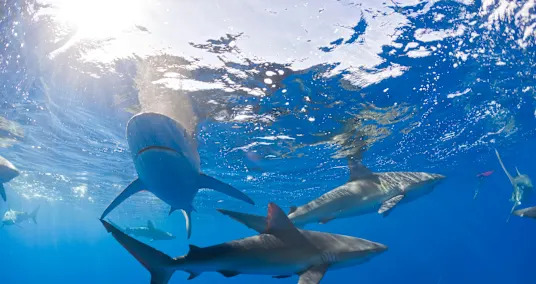
Sharks in the Bahamas are consuming substances including caffeine, painkillers and even cocaine, according to a new study by marine scientists who say it could potentially impact the animals' health and behavior.
The research team, made up of marine biologists and scientists from a variety of international programs, analyzed blood samples from 85 sharks of five different species. The sharks were captured about four miles off the coast of a remote island and their blood levels were tested for 24 legal and illegal drugs.
Twenty-eight of the sharks had detectable levels of caffeine, two common over-the-counter anti-inflammatory painkillers, or, in one instance, cocaine in their blood, according to the study. Some tested positive for more than one substance.
Medications, illicit drugs and other substances are "increasingly recognized as contaminants of emerging concern" in oceans and other bodies of water, the researchers said. They noted areas that are "undergoing rapid urbanization and tourism-driven development" are especially at risk. This is the first study looking at the effect of these contaminants on sharks in the Bahamas, the researchers said.
"While the detection of cocaine — an illicit substance — tends to draw immediate attention, the widespread presence of caffeine and pharmaceuticals in the blood of many analyzed sharks is equally alarming," said lead author Natascha Wosnick, a zoologist and associate professor at the Brazil's Federal University of Parana, in an email to CBS News. "These are legal substances, routinely consumed and often overlooked, yet their environmental footprint is clearly detectable. This underscores the need to critically reassess even our most normalized habits."
The data showed the sharks with contaminated blood had changes in metabolic markers, including those tied to stress and metabolism. The researchers said it's not clear if the changes are harmful, but it's possible they could lead to behavioral changes.
"Our primary concern is not an increase in aggression toward humans, but rather the potential implications for the health and stability of shark populations," Wosnick said. "Chronic exposure to these anthropogenic compounds, many of which have no natural analogue in marine systems, may lead to negative effects that are still poorly understood."
The researchers said that the data highlights "the urgent need to address marine pollution in ecosystems often perceived as pristine."
Tracy Fanara, a marine biologist who worked on a Discovery TV show called "Cocaine Sharks" that explored how sharks might be affected by the drug, told CBS News in 2023 about experiments that simulated cocaine exposure. She said it led to "strange behavior" that requires more research. During the show, she can be heard noting that a hammerhead shark appears to be pursuing a bale of fake cocaine.
"My goal of this experiment was to shed light on the real problem of chemicals in our waterways and impacting our aquatic life and then eventually impacting us," Fanara said in 2023. "But the goal of the study was basically to see if this is a research question worth exploring more. And I would say, yes, it is."
In a separate study from 2024, scientists reported that sharks in the waters off Brazil tested positive for cocaine and benzoylecgonine, the primary molecule in cocaine. Those researchers looked at the levels of the substances in the sharks' liver and muscles. Each of the 13 sharks examined for the study tested positive for high levels of cocaine, CBS News reported at the time. The research team said more data would be necessary to see how cocaine and other substances affect sharks and other wildlife.
Spoiler alert! "NCIS" star Rocky Carroll talks major twist in the show's 500th episode
Latest on jury deliberations in California social media addiction case
LATEST POSTS
- 1
 Fireballs and a full moon. Here’s how to see two celestial events this week
 - 2Three arrested in Paris after attempted bomb attack outside Bank of America
- 3Passenger Missing After Going Overboard Disney Cruise Ship
- 4Australia PM tries to reassure public as panic buying sees fuel demand surge 400% in some regions
- 5The most effective method to Decisively Use Open Record Rewards





- China Just Got Another Cheap EV America Would Love to Have
- Research institutions tout the value of scholarship that crosses disciplines – but academia pushes interdisciplinary researchers out
- Gartex Texprocess India to showcase innovations across textile ecosystem
- What you need to know about Trump accounts as Michael and Susan Dell donate $6 billion to the new early childhood investment program
- When fake data is a good thing – how synthetic data trains AI to solve real problems
- Mating injuries may lead scientists to identify dinosaurs’ sex
- Instructions to Redo Your Kona SUV for Improved Tasteful Allure and Usefulness
- Instructions to Keep an Inspirational perspective After Cellular breakdown in the lungs Treatment
- The Force of Care: Living with Goal