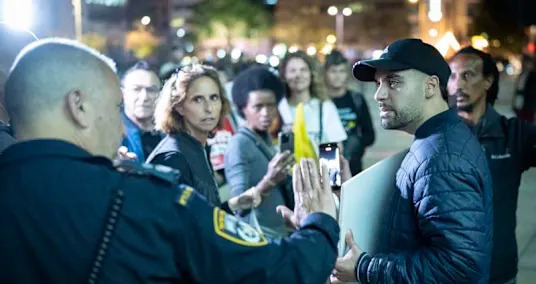
Protests took place in Tel Aviv, Jerusalem, Haifa, and Beersheba, as a survey found broad but uneven support among Jewish Israelis for Operation Roaring Lion.
Israel Police arrested 21 anti-war protesters Saturday night as demonstrations against the conflict with Iran expanded in multiple cities despite restrictions on public gatherings.
Protests took place in Tel Aviv, Jerusalem, Haifa, and Beersheba, with hundreds of participants reported in Tel Aviv and Jerusalem and about 100 in Haifa, marking the largest turnout since weekly demonstrations began. Authorities said 13 people were arrested in Tel Aviv and eight in Haifa.
Police said the gatherings were not approved under Home Front Command regulations that ban events with more than 50 people. Officials said the increase in turnout followed calls by groups opposing the government to protest despite the restrictions.
“During a situation assessment that took place at the scene with a Home Front Command representative… it was clarified that there was a real risk to human life and accordingly, Yarkon [precinct] police commander Tzachi Sharabi ordered the gathering to be dispersed,” police said.
Hadash-Ta’al chairman Ayman Odeh, an Arab lawmaker involved in the protests, criticized the police response, calling officers fascists “in the service of the government” and saying they were afraid of “the heroic citizens who went out, despite everything, to make their voice heard.”

Survey shows broad, uneven support for war
The demonstrations come as a March 2026 survey by the Israel Democracy Institute found broad but uneven support among Jewish Israelis for Operation Roaring Lion. Support was strongest on the Right at 87% and about half on the Left.
The survey also found that Jewish and Arab respondents largely agreed that Iran’s resilience has been stronger than expected. Most Jewish respondents said Israeli society could sustain the campaign for up to one month, while 28% said as long as needed. Arab respondents were less optimistic about how long the public could endure the conflict.
A majority of Jewish respondents said Prime Minister Benjamin Netanyahu’s decision was driven by security considerations, while most Arab respondents viewed it as political.
LATEST POSTS
- 1
 Merck sees over $5 billion opportunity in Cidara's experimental flu drug
 - 2Figure out How to Track and Anticipate Future Cd Rates
- 3Book excerpt: "Eat Your Ice Cream" by Ezekiel J. Emanuel, M.D.
- 4Tech Patterns: Contraptions That Will Shape What's in store
- 5James Webb Space Telescope finds strongest evidence yet for atmosphere around rocky exoplanet: 'It's really like a wet lava ball'




- Figure out How to Pick the Right Dental specialist for Your Dental Inserts
- The most effective method to Pick A Trade-in vehicle Stage
- Figure out How to Explore Your Direction to the Best Dental Embed Trained professional: A Far reaching Manual
- Instructions to Utilize Your Brain science Certification to Work on Corporate Culture
- Japan deploys the military to counter a surge in bear attacks
- CDC vaccine panel delays vote to stop recommending hepatitis B shot at birth
- Iconic iceberg turns blue, on verge of totally disintegrating, NASA says
- Recent studies prove the ancient practice of nasal irrigation is effective at fighting the common cold
- Malaysian broadcaster rejects altered graphic about electricity rate hike