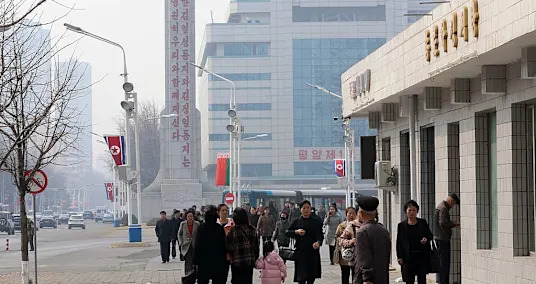
China has announced that its flag carrier, Air China, will resume direct flights to North Korea after a six-year pause, following the restoration of passenger train services between Beijing and Pyongyang.
This marks a significant step toward reopening North Korea, one of the world's most isolated nations, to the world.
Transport links between the two capitals had been suspended since the start of the Covid-19 pandemic in 2020, when Pyongyang implemented a very strict border closure.
While North Korean carrier Air Koryo already resumed flights to Beijing in 2023 and allowed Russian tour groups to visit in 2024, the return of China's air and railways are seen as a major economic milestone, as China has for decades been the main trading partner and a key source of diplomatic and economic backing for the country of 26 million people.
Before the pandemic, there were an estimated 300,000 foreign visitors in 2019, according to South Korea's Institute for International Economic Policy, and Chinese visitors accounted for 90% of all tourists to North Korea. Therefore, the long delay in resuming regular travel had surprised many regional observers.
"The reopening of these borders has been driven primarily by Pyongyang's timeline, which challenges the outdated assumption that Beijing dictates terms to a dependent client state," Seong-Hyon Lee, a visiting scholar at the Harvard University Asia Centre, explains.
Related
Nuclear ambitions complicated the relationship
Despite being Pyongyang’s primary ally, Beijing has frequently voiced disapproval over the North's persistent missile tests and nuclear ambitions. This aspect created a bumpy relationship with Pyongyang, with analysts saying that a nuclear-armed North Korea has often been something of a liability.
The diplomatic normalisation was highlighted last September, when Kim Jong Un attended a massive military parade in Beijing alongside Russian President Vladimir Putin. This was Kim's first appearance at a Chinese military display.
Lim Eul-chul, a North Korea expert at South Korea's Kyungnam University, argues that the war in Iran, in particular, increased "the need for closer coordination between the two nations".
LATEST POSTS
- 1
 Become the best at Discussion: 6 Procedures for Progress
 - 2Scientists dove hundreds of feet into the ocean and found creatures no human has ever seen. Our trash beat us there
- 3Astronauts head home early after medical issue
- 4Reality TV star Spencer Pratt, who lost his home in Palisades Fire, is running for mayor of Los Angeles
- 5L.A.'s most famous midcentury home, the Stahl House, is on the market for the 1st time, at $11K per square foot: See inside


- Supreme Court case about ‘crisis pregnancy centers’ highlights debate over truthful advertising standards
- UK can legally stop shadow fleet tankers, ministers believe
- Satellite data reveals a huge solar storm in 2024 shrank Earth's protective plasma shield
- 5 Worldwide Road Food varieties You Should Attempt
- Voting begins in Uganda’s presidential election during internet shutdown and polling station delays
- British Columbia's Secret Lakeside Town With Hot Springs Is 'An Oasis Of Arts, Culture And Relaxation'
- Reporter's Notebook: The Post embeds with foreign armies visiting the IDF
- Astronomer captures 2 meteors slamming into the moon (video)
- Israel has clear objectives south of Litani River, but will face difficult choices further north